
Next Event:
View Our Events Diary



“Being a mentor, helping a young professional develop their skills, is very rewarding. As well as sharing my own insights and experience I’m also listening. This means I can really see things from my mentee’s perspective and am seeing things anew myself. Amongst other things I now have a far deeper understanding of life in a law firm, which will help me in my role as a relationship manager.
“My mentee is very fully engaged in the process and we’ve met regularly. This commitment means we have approached the process professionally and are both benefitting!”
James Oliver: Relationship Manager – Commercial, Yorkshire Bank

Andrew Smith, partner at Shakespeare Martineau and the incoming Chair of Coventry & Warwickshire First, has set out four principle objectives for his year in office.
– Talent development
– Building the voice of the professional
– Keeping members informed
– Growing the membership
Talent development
As the economy returns to healthy and sustainable growth so the professional services sector is also returning to growth. Attracting good talent in this competitive market is challenging, particularly in the face of the high salaries offered by Birmingham and London firms. Retaining our own talent is also a challenge in this context.
The mentoring programme has already proved successful in addressing this skills challenge. Paired with a leading professional, the region’s talented young individuals are able to accelerate their development.
My ambition is to build on this excellent platform and continue to develop the talent within our region, helping them achieve their career and life goals. This approach will support the growth of our own members and enable local business to access an increasingly broad range of capabilities on their doorstep.
Voice of the Professional
Earlier this year Coventry & Warwickshire First kicked off a consultation process designed to develop a detailed understanding of the issues facing members and their clients: Driving Economic Growth in Coventry & Warwickshire.
The consultation deepened our understanding of the issues and challenges in the local economy and the role and contribution of our members. We now need to project our voice and engage with key stakeholders in the region to advocate on behalf of our members and their clients. This will also involve boosting our profile in the local media.
Keeping members informed
Through a comprehensive programme of events Coventry & Warwickshire First members are kept informed of key initiatives within the region and given behind the scenes access to new developments and some of the region’s most high profile organisations and venues.
This programme will be sustained during my year, with a number of key events already planned. These include a quarterly breakfast titled ‘Leadership for Today and the Future’, a debate on the forthcoming EU referendum and First Friday events at Coventry Cathedral, the Council House in Coventry and the Royal Shakespeare Company.
Growing the membership
Under Martin Gibbs’ stewardship Coventry & Warwickshire First has been reinvigorated. The organization is clearly the voice of the professional, gives members valuable insights, and supports the development of relationships that grow business.
With the Coventry & Warwickshire First board as advocates, I intend to spread the word to professional services firms throughout the region and encourage them to join so they too can reap the rewards of membership.
I am delighted to be taking up the reins of Coventry & Warwickshire First and looking forward to building on the strong platform established by Martin Gibbs.
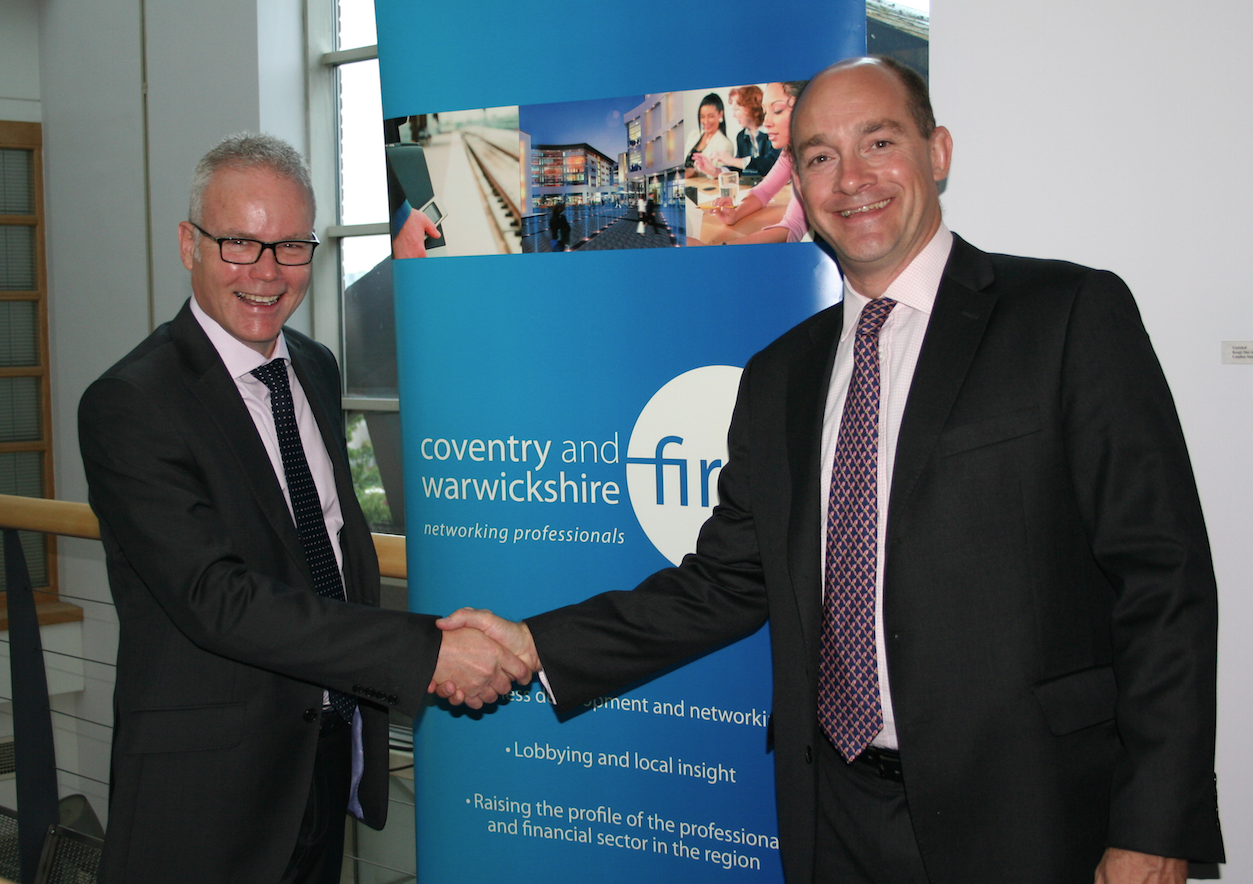
Talent development and a clear voice for the region’s professionals: Coventry & Warwickshire First’s agenda for 2015 / 16
“One of the real challenges facing professional services firms in Coventry and Warwickshire is attracting, retaining and developing great talent,” said Andrew Smith, speaking at an event to mark his appointment as Chair of Coventry & Warwickshire First for 2015/16. “I intend to work with our Young Professionals to build on the success of our mentoring programme and develop our young talent further.”
Andrew Smith, a partner in law firm Shakespeare Martineau, is taking over from Martin Gibbs, Managing Partner of Dafferns Chartered Accountants. Andrew joined Shakespeare Martineau, which employs 120 people in its Stratford on Avon office, in 2009 and has been a board member of Coventry & Warwickshire First, the leading networking group for business services professionals in Coventry & Warwickshire, since 2011.
During his year in post Martin Gibbs kicked off a consultation process designed to develop a detailed understanding of the issues facing members and their clients: Driving Economic Growth in Coventry & Warwickshire. A key issue highlighted by the consultation is the challenge of attracting and retaining talent in a bouyant recruitment market.
The mentoring programme, also launched under Martin Gibbs’ stewardship, has already proved successful in addressing this skills challenge. Paired with a senior professional the region’s talented young individuals are able to accelerate their development.
“My ambition is to build on this excellent platform and continue the process of developing the talent within our region so local businesses can access an increasingly broad range of capabilities on their doorstep.
“The consultation process also deepened our understanding of the issues and challenges in the local economy and the role and contribution of our members. We are now taking our findings forward, projecting the voice of the region’s professionals to key stakeholders and showcasing the skills we can deploy to support businesses in the area.”

During his year in office as Chair of Coventry & Warwickshire First (2014-2015) Martin Gibbs, Managing Partner at Dafferns Chartered Accountants has “worked closely with the new Secretariat and reinvigorated the organisation.
Under his stewardship Coventry & Warwickshire First has truly:
– Become the voice of the professionals,
– Helped members develop relationships that grow business, and
– Provided valuable insights into the region, its economy and the challenges facing local businesses.
Reflecting on his year in office he cited his key achievements as reinvigorating the events programme, leading a valuable consultation with members and supporting the launch of the mentoring programme.
“High quality, interesting and informative events are the lifeblood of Coventry & Warwickshire First. They bring our members together whilst informing and engaging them with key issues and influencers within the region.
“Our programme of quarterly events adds substantial value to members and this year included a lively debate amongst business leaders about the challenges to growth being faced by the region. They cited an acute skills shortage and confusion surrounding funding and grant support as the key issues. As the voice of professionals we are now taking these issues forward and advocating on behalf of our members amongst those with influence in the region.
“The final quarterly breakfast of my term is one on procurement. In direct response to requests from our members we brought together procurement professionals from the public and private sector to give members the inside track so they can make sure they are well placed to win important tenders.
“First Friday is a relaxed, monthly gathering of our members, giving them the chance to connect with colleagues while getting behind the scenes access to one of the region’s key organisations or venues.
“This year we kicked off a consultation process designed to develop a detailed understanding of the issues facing members and their clients: Driving Economic Growth in Coventry & Warwickshire. We held four private dinners, each one themed around one of our sectors – finance, legal, property and business services professionals. Each was very different, with the members engaging in lively informed debates.
“Abiding by the Chatham House Rule we gathered the opinions expressed at the dinners into a series of reports and are now in the process of defining the key elements and establishing proactive campaigns to take them forward.
“Our members loved the format of the dinners so we intend to develop it and there are plans for cross-sector dinners to be held in the forthcoming year.
“The skills shortage has repeatedly been cited as one of the biggest challenges facing both our members and their clients. Launched during my year the mentoring programme is already having a positive impact on this issue. Paired with a leading professional the region’s talented young individuals are able to accelerate their development. Their feedback, as well as that of the mentors themselves is incredibly positive.
“We have achieved a great deal during 2014 / 15 and I am delighted to be handing on a vibrant organization delivering real value to its members to my successor.”

Making new contacts through networking is important in my job: to raise the profile of The HR Dept (South Warwickshire).
Our business has grown rapidly over the last ten years through referrals. Over the two years we have been members of Coventry and Warwickshire First, we have met many local business owners at the monthly meetings who have benefitted from our support.
The events are thoroughly enjoyable and informative. The membership has been very worthwhile for us – we would recommend it to all local businesses.
Jacqui Murtough, The HR Dept
“Membership of Coventry & Warwickshire First provides excellent opportunities to interact with the wider professional community in the region.
“It is an ideal platform for bringing together the key professional advisors in the Coventry & Warwickshire area across the full range of sectors.
“The network, provided through the Bank’s membership, is a valuable way of keeping up to date with both activity and the views of businesses across the area.”
Keith Boxley, Relationship Director at Barclays Bank

A trainee accountant with Dafferns Chartered Accountants, Sophie Breeze joined the mentoring programme to gain an insight into how to grow as a young professional and develop her career.
“I’ve enjoyed meeting my mentor; the informal setting made it easy to chat and get to know each other. I’ve also met her at more formal networking events and having already developed the relationship has really helped on these occasions.
“I know I’m not alone in being a little intimidated at networking events and have now got some really good tips that I am putting into practice. I’ve also now got a useful contact who will always be a friendly face at these events.
“Developing a compelling CV is also important to me. My mentor has given me an insight into what employers look for so I know what areas I need to focus on and improve.”

A mentor through the Institute of Enterprise & Entrepreneurs Keith Boxley, Relationship Director at Barclays Bank plc quickly stepped forward to join Coventry & Warwickshire First’s mentoring programme.
He is mentoring a young accountant.
He explained: “I can remember how valuable I found support of this sort at the early stages of my career and saw this as good opportunity to give something back.
“We’ve developed a positive, confidential relationship within which my mentee can be straightforward and raise any careers elements that concern her. She can be very honest and I think we’ve made a lot of progress in a short period of time.
“I’ve also learnt a lot. Talking to my mentee has made me think about how I might have approached situations a little differently. My active listening skills have definitely improved, the goal being to help my mentee find her own solutions rather than tell her what I would do.
“I’ve found this an incredibly positive experience. It’s easy to take our own skills and experience for granted but the ability to use that experience and insight to help someone at the earlier stages of their career has a real value and isn’t something we should overlook.”

During the spring and summer of 2015 legal, financial, property and businesses services professionals came together to discuss the issues affecting the economic growth of their clients and their own firms.
This report summarises the key points of the discussions.
Factors affecting growth in Coventry and Warwickshire
Local investment agencies
There is a perception that the current investment agencies lack a coherent approach and there is no clarity as to the type of jobs being attracted to the region.
In particular the lack of long-term stability in the leadership of the Local Enterprise Partnership is perceived as a weakness for Coventry and Warwickshire.
Access to finance
Funding is a recurring issue faced by the small and micro businesses typical to Coventry and Warwickshire.
There is a need for unsecured lending to businesses with a strong balance sheet; the perception that banks only provide secured funding remains. This being accepted as true it is to be expected that the continuing decline in commercial property values is negatively affecting access to finance.
There is a question mark over the equity of funding deals available in Birmingham versus those available in Coventry and Warwickshire. Some advisers clearly stated the terms they can obtain in Birmingham are better than in Coventry.
Our universities
Coventry University and the University of Warwick are both world class and have a reputation for driving innovation. Combined they are a powerhouse for the sub-regional economy providing global links, creating jobs locally, attracting often extremely wealthy international students, bringing plenty of student pounds into the region as well as a flow of very high quality talent.
Hubs
Silicon Spa, gathered around Royal Leamington Spa, is a hub for the thriving computer gaming industry and the success of Jaguar Land Rover has supported the development of a hub for design and performance engineering.
Intellectual property (IP) is an important factor in the success of these industries. Funders demand it; it is an essential element of the value of a business. Business owners need to recognise the value of investing in IP early on.
Facilities
High speed Internet is important for growth and the investment made to transform Coventry into a gigabit city is highly valued. Improving the connection in rural areas is also necessary.
Access to commercial premises
There may be plenty of commercial premises in and around Coventry and Warwickshire but there is little flexible, high quality office space. This constitutes a barrier to growth as businesses struggle to find premises that will allow them to take the next step.
Against this backdrop Friargate is a very important development but it is noted that there will be little space available to SMEs.
The depth, breadth and calibre of advice in the region
Coventry and Warwickshire is home to many excellent professional and financial services advisory firms. Collectively they have the capability required to support the growth of micro-businesses and SMEs, advising on everything from exporting to employment law.
However many micro and small businesses opt for the false economy of getting information from the Internet instead of expert advice from qualified professionals.
The Growth Hub and the Clearing House have both been created to provide micro business and SMEs with the advice they need. However the Growth Hub is only as good as the number and quality of local professionals hot-desking there and it is possible to see the Clearing House as devaluing the advice of the professional services.
There is perceived to be a sales and marketing gap amongst small businesses in the region. The product or service may be excellent but the business lacks the knowledge and ability to market and sell it effectively.
The legal sector is evolving. The traditional culture of hourly rates is increasingly a thing of the past as law firms focus on developing deeper client relationships based on something more than simply the provision of legal services. Adding value is the mantra.
Following the lead of city law firms, firms in Coventry and Warwickshire are shifting from the traditional structure of being led and governed solely by lawyers. Operational boards are increasingly the norm with the firm’s partners being the shareholders to which the board is accountable instead of being the day-to-day managers. Consolidation, also a trend, is being driven by a number of factors. Some firms are merging to grow, broadening their skills set and generating economies of scale to capitalise on market opportunities. For others mergers are designed to provide a means of retirement or are in response to the escalating cost of Professional Indemnity insurance.
Success or failure depends on the strength of management and leadership
Businesses succeed or fail on the strength of their management. The final ‘straw’ may be something very specific but strong management and good leadership will ensure the business minimises its exposure to risk and is able to adapt to survive.
Family businesses are particularly vulnerable to weak management. The second, third or fourth generation family members may inherit the position of leading the business but not necessarily the skills or outlook to do so.
The sub-region’s leaders need to be able to access good advice and support, with mentors able to guide them and provide a sounding board.
The JLR phenomenon and conundrum
Jaguar Land Rover (JLR) is an incredible success story, driving innovation and investment into the region. Hundreds, if not thousands of businesses, have flourished in the supply chain, creating employment and wealth throughout the West Midlands. Valuable skills have been developed in the area as a result of its presence and it has played a part in initiatives such as the Warwick Manufacturing Group, which have put Coventry and Warwickshire firmly on the Global map. JLR also runs a number of initiatives through which both the company and employees give something back to the local community.
Coventry and Warwickshire needs to go on capitalising on the positive and beneficial influence of JLR.
JLR also, however, presents a number of challenges that should not be ignored. The dominant effect of this one company on the sub-regional economy is a potential weakness. It is difficult to strip out the JLR effect and properly assess the underlying strength of the local economy. It could be that fundamental weaknesses are being masked.
As well as the obvious regional risk of over reliance on one business, the JLR phenomenon is affecting the availability of skills and access to housing. As a successful global business JLR is ‘hoovering up’ the skills in the region offering excellent career opportunities and salary and benefits packages with which smaller companies struggle to compete. House prices have also increased in the area and the private rental sector is saturated, resulting in an unbalanced housing market.
These issues cannot detract from the overwhelmingly positive impact of JLR but it would be a mistake to ignore them and not seek remedies.
The skills challenge
Rugby is home to many logistics businesses and so there are plenty of warehouse and related jobs in the region. At the other end of the spectrum are high-level engineering roles but there is an absence of mid-tier jobs, a gap that needs to be filled if there is to be a balanced workforce.
As indicated earlier there is a skills shortage. Apprenticeships are an effective solution and businesses feel they need to invest in them, despite the risk of young people leaving quickly.
The lack of work readiness amongst young people is perceived to be an issue. Most businesses feel they have been ‘burnt’ in one way or another by inexperienced young people and have adopted strategies to make sure they take on only the best. These include assessing them on their attitude ahead of their skills, getting existing apprentices and young people to interview the next cohort of recruits and only selecting those who have experience beyond the school environment.
A relationship between businesses and schools could help to address this problem. Schools focus on delivering good exam results rather than producing work ready young people. Closer collaboration between the two could give greater prominence to and support with the life and softer skills young people appear to lack.
The older workforce presents another solution. Traditionally young people were apprenticed to a specific individual who coached them on the working world as well as the craft skill itself. With the lifting of compulsory retirement there are now older people in the workforce who could be the mentors the young people need.
Professional and financial services firms themselves are also experiencing the pain of the skills shortage. Within the property sector there are not enough qualified architects and surveyors and building trades skills. The scarcity of qualified and registered valuers is really beginning to show, particularly now the banks are willing to lend.
As the economy recovers and activity in the legal sector gains momentum law firms need talented lawyers who are one to six years experience post qualification to capitalise on the market potential. During the downturn however the number of trainees was reduced so there are few at this level available now. To compound the problem Birmingham firms are poaching those there are, tempting them with the promise of higher salaries. Local firms are developing their own talent, identifying paralegals with the potential and ambition. Pushing what the region has to offer, in terms of career and lifestyle may also combat the pull of Birmingham.
A lack of skills can also be tackled through innovation and improved efficiency.
The regional offer
Growth is also dependent on attracting key individuals to the region. In particular, chief executives need to opt to live and work here.
Coventry and Warwickshire has a good offer that includes culture, countryside, and good transport links, but there is little that is truly unique to differentiate the sub-region from other locations. Furthermore the housing stock may not be sufficiently high calibre.
There is also a debate as to whether the region should promote excellent career opportunities for those in the professional services or a good work / life balance.
Geography
The West Midlands Combined Authority (WMCA) will pool resources and support the growth of the local economy, giving Coventry access to existing funding streams.
The WMCA does give cause for concern. Growth in Warwickshire is likely to be constrained as the WMCA will pull the available funding into the urban areas.
There is also a cultural challenge; geographically it is not seen as making sense. Coventry and Warwickshire represent a cohesive unit; according to the Coventry & Warwickshire Local Enterprise Partnership over 80% of those who work in Coventry and Warwickshire live in Coventry and Warwickshire. There are also a number of organisations already reflecting this geography; Coventry & Warwickshire First, Coventry & Warwickshire Chamber of Commerce, the Champions, the LEP, BBC Coventry & Warwickshire. The view is that the city of Coventry and the county of Warwickshire should collaborate.
Introducing the artificial boundaries of the WMCA into the region of Coventry and Warwickshire will compound the challenges that already exist in relation to local authority boundaries with regard to planning and development. Coventry, along with South Warwickshire, has developed almost every piece of brownfield space. To grow economically the city needs to expand beyond its boundary but it is being stopped from doing so by the planning decisions of neighbouring authorities. The boundaries are meaningless to business, which instead of demarcations wants collaboration and cohesion to the economic benefit of all.
Promoting Coventry and Warwickshire
The sub-region promotes itself better to the outside world than has been the case in recent decades. Coventry Champions proactively promotes Coventry and Warwickshire to London and the rest of the country and is making connections with successful businesspeople who have an emotional connection with the region. There is already awareness of, for example, Silicon Spa but a perception that few know the whole Coventry and Warwickshire story.
As well as Champions there are other organisations tasked with driving growth in Coventry and Warwickshire and attracting inward investment. These include Coventry City Council, Warwickshire County Council, the Local Enterprise Partnership, the Chamber of Commerce, the Growth Hub and of course Coventry & Warwickshire First. Working collaboratively these organisations could constitute a powerful lobby able to communicate the full story to a wider audience.
More is demanded of the region’s politicians. They need to be lobbied and then held to account. In addition the big institutions, for example the universities, should be lobbied to buy their products and services locally.
Finally, there is a strong belief that Coventry and Warwickshire needs a strong leader or cohort of leaders to make sure all take responsibility for improving the city and tendering for major high profile projects.
The rural economy
There are a number of issues that affect the rural economy in Warwickshire:
The rural economy itself is under-emphasised, the strong food production businesses in the region too often being overlooked.
Diversity
With the Government on track to achieve its target of women accounting for 25% of board members of FTSE 100 companies, there is more to be done amongst firms within Coventry and Warwickshire. The black and minority ethnic representation is also poor. As a consequence the firms are not fully tapping into the potential talent available.
The risk of ghost towns
Coventry city centre is being improved. The renovation around the Council House, the Friargate development and the new access to the railway station are positive.
However there is concern that towns in the region could become ghost towns – Coventry is already a ghost town in the evenings – if there is a not a commitment to ensure a positive balance of office, residential and leisure facilities in the centres. Office facilities are needed for the lunchtime pound and an appealing nighttime economy is needed to attract workers at the end of the day and make the centres a destination for additional visitors.
Property-specific issues
The politics of planning and the power of nimbies
The biggest single challenge facing the property sector in Coventry and Warwickshire remains the planning process. The process is perceived as expensive and time-consuming, presenting a significant commercial risk to developers.
The Government’s “more for less” agenda appears to be unhelpful in ensuring the Local Authorities have the right resource to deal with planning matters at the right level.
Local authorities are viewed as being imbued with a risk-averse culture that means planning officers are reluctant to make recommendations to planning committees without fully exploring every potential issue, despite their experience and expertise.
At the same time nimbies are getting better and better at deploying tactics that slow down if not block new developments; if the process is too slow developers pull out and look for easier sites. This attitude means Coventry and Warwickshire is missing a number of economic growth opportunities from investors, local and international, who wish to do business here in the region.
Nimbies raise issues ranging from rare local wildlife to flood risks and developers are then forced to obtain a whole array of specialist reports, submitted as part of the planning application. This represents a commercial risk; developers commission the reports with no knowledge as to whether or not they are likely to get planning permission. Instead, planning officers should establish if there is any substance to the nimbies’ arguments before calling for specialist reports.
Compounding these challenges is the approach of councilors, who are perceived to make partial, highly politicized decisions. Without a good planning reason, councillors block applications that may be positive for the wider area but unpopular locally in the expectation they will be approved on appeal.
This approach has blocked developments in the greenfield. This may seem appropriate but there is little if any brownfield development space left within Coventry, which means greenfield developments are the only option for growth.
Closed for business?
There is concern Coventry and Warwickshire is ‘closed for business’. Cuts mean there are fewer and fewer planning and conservation officers in post, making it harder for local authorities to respond positively and proactively. There is also a belief that the solution-oriented attitude found in places like Leicestershire is absent from Coventry and Warwickshire.
A strategic vision
To support economic growth an ambitious, long-term strategic vision is needed; one that looks at least 15 years ahead, is unconstrained by artificial boundaries and views Coventry and Warwickshire in the broadest sense.
Facilitating investment in Coventry
Following the Second World War Coventry City Council re-developed the city centre, selling 99-year leases to developers. Those leases are now not long enough to support investment. Naturally the City Council must extract ‘best value’ from these assets but its consequent reluctance to sell new long-term leases or the freeholds to key industrial estates and the areas surrounding the city centre means new development on the land is effectively blocked, hampering economic growth. The constraints of long leases running down on the industrial estates are the greatest peril. The estates of the 1950s, 1960s and 1970s are in desperate need of reinvestment but this is not possible where there is just 50-70 years left on the least. In tandem, JLR, The London Taxi Company etc are booming and there is a real shortage of good workshops and warehouses for suppliers.
Investment is needed to turn the city centre into an attractive night-time and weekend economy but with easier development opportunities elsewhere in Warwickshire and beyond a change in the near future is unlikely.
Preservation vs conservation
While property experts are concerned about buildings that arguably do not warrant the status of being listed, the real issue is the attitude of conservation officers. Buildings should be allowed to evolve with uses relevant to today rather than be preserved, their uses rigidly fixed at the time they were built.

Six months on from its conception Coventry & Warwickshire First’s mentoring programme is proving its value, home growing talent as a means of tackling the acute skills shortage.
As the potential of the region’s professional services sector for growth increases in line with the area’s economic growth its expansion is being hampered by an acute skills shortage, made worse by the high salaries offered by Birmingham and London firms.
Coventry & Warwickshire First board member Martyn Howard is one of the driving forces behind the programme, working closely with the Young Professional network to deliver it. It pairs the region’s leading professionals with young people from another sector, helping them accelerate their personal development.
Speaking about the value of the programme Martyn Howard explained: “Having access to a mentor at the start of your career can really help you make the right decisions.”
Lucy Webb of Band Hatton Button continued: “I’m thinking about where to take my career at the moment and so joined the Scheme with the specific goal of exploring my options.
“The informal style of the sessions made it very easy to chat and by tapping into my mentor’s first hand experience I feel I’ve gained a great deal. I can now see many more opportunities than I was aware of and feel doors have opened.”
For Paige Howitt of SFB Group the mentoring programme has helped her build her confidence. “The relationship with the mentor is informal so it’s easier to talk openly than it would be with a colleague or my manager,” she explained. “As a result he has given me some great feedback and helped me understand my strengths and areas for improvement. He’s also shared some of his early experiences.”
Mentors are also benefiting from participation, often in unexpected ways. “I’ve learnt a lot,” said mentor and Relationship Director at Barclays Bank, Keith Boxley. “My active listening skills have definitely improved, the goal being to help my mentee find her own solutions rather than tell her what I would do.”
James Oliver, mentor and Relationship Manager – Commercial at Yorkshire Bank, has also valued the need to listen. “Needing to listen means I can really see things from my mentee’s perspective and am seeing things anew myself.”
Susan Hopcraft of Wright Hassall, pointed out the value of women participating in the programme as mentors. “I suspect women more than men need this type of support,” she said. “Men seem to have more role models in senior positions so women who are prepared to be mentors have an important role to fill.”
To find out more about the Mentoring Scheme, whether a potential mentor or mentee, email Coventry & Warwickshire First at admin@coventryfirst.co.uk.